
a beautiful simplicity
Here in Marnaves, South West France, the north wind and the winter chill has left us and spring has sprung into life! The birds are singing their hearts out, including a solo nuthatch that my neighbour tells me has been looking for a mate for a month. Another local described to me a pair of cuddly barn owls that appear together at twilight. My lemon verbena plant, which was characteristically pretending to be dead, has suddenly sprouted the tenderest little green leaves, and our huge moss- and lichen-covered Judas tree is coated with deep pink ‘tears’ that appear straight out of the bark. The whole tree hums optimistically with the buzzing of large and happy fat bumble bees collecting pollen. And, in the market, there are large mounds of beautiful local asparagus with their plump, elegantly curving leaf buds and sturdy stems.
So how to cook this culinary wonder, that arrives in splendour but which leaves us within two months? My answer is in a way that maximises its enchanting flavour and, if anything, magnifies it. In other words: as simply as possible.
For me, this queen of vegetables can be enhanced with an appropriate, sensitive partner. Most simply of all, some melted artisan-made butter. This is more widely available than you might think: I can get it in Cardiff as well as Cordes market.
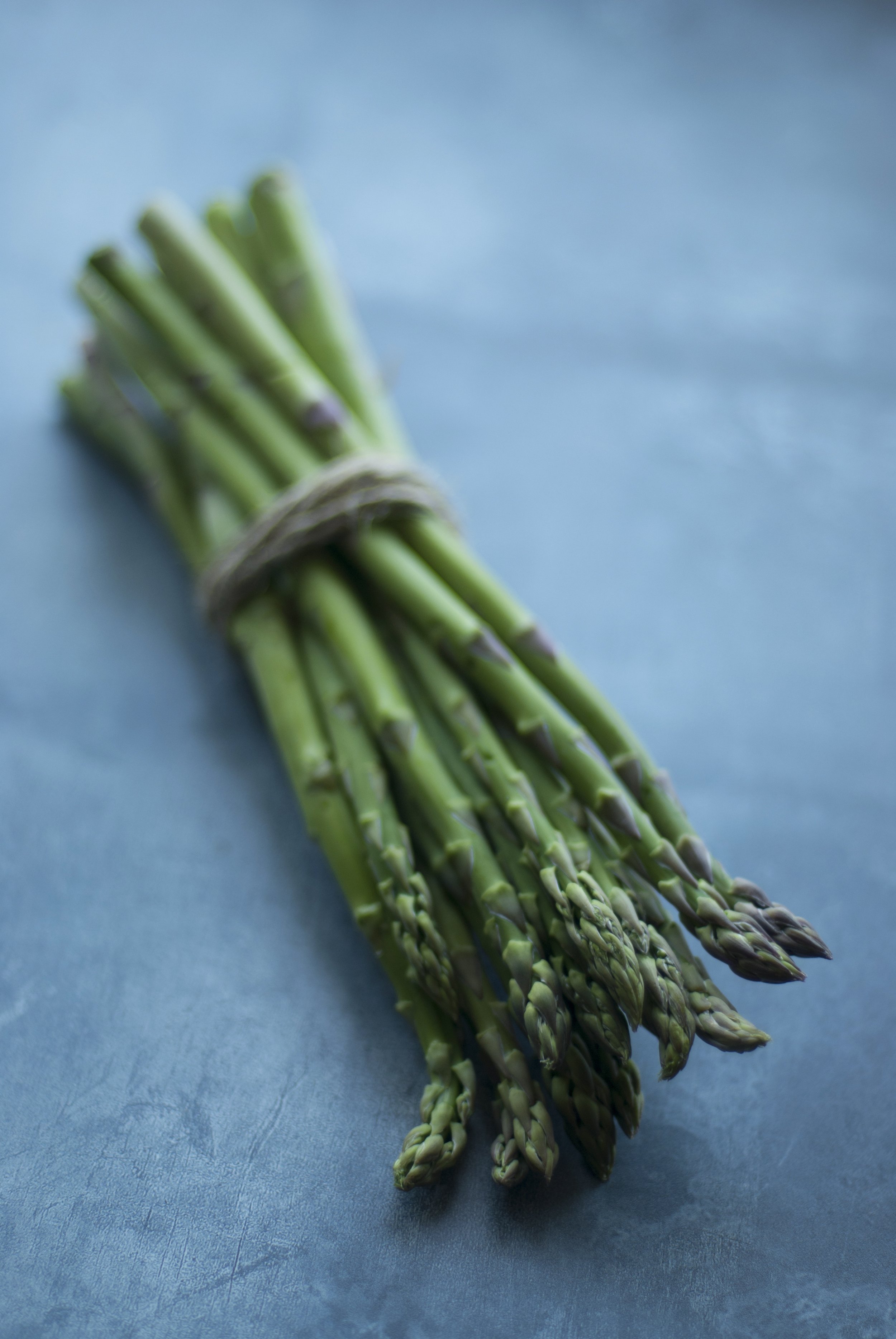
A bunch of curiously elegant – and uniquely delicious – asparagus
Another good dance partner is mayonnaise – homemade, of course. I don’t understand why there is so much commercial stuff around when it is so easy to make (see p256 of my book). Homemade is, for me, the only type of mayonnaise worthy of asparagus. I use the small bowl of my Magimix, but a stick blender and a jar work brilliantly, as do (if you have the energy) a good old-fashioned whisk and a bowl. I like to make it with a little top quality Spanish vinegar and/or some lemon zest or juice, and sometimes add a little garlic (my recipe for aioli is here). Yesterday, on impulse, I put in some sorrel plucked from my garden – I simply removed the spines of the leaves and blitzed them in. I made it just before my guests arrived and when I tasted it I wasn’t convinced that I had done the right thing. But half an hour later, when we came to eat it with our asparagus starter it had settled down and tasted exactly as I’d originally hoped. One of our guests was my friend Ursula (who inspired the Fig and Olive Tapenade and Seeded Crackers recipes) and she thought it was good.
It pleases me that simplicity has been at the heart of French cuisine ever since its beginnings in the mid-seventeenth century. Chefs aimed at le goût naturel (the natural taste) or le vrai goût (the true taste) and had an overarching objective of delighting the senses. Still in fashion today, this style of cooking thrives on using the very best seasonal produce of the moment. And right now, that’s asparagus!