
pumpkins
Whilst I was staying in France this summer, the pumpkins in my Cardiff garden, relishing the unusually hot weather, got to work like never before. On my return home, I found a network of pumpkin plants sprawling all over the borders, the lawn, making themselves at home among the asparagus and all over the stone walls, their delicate tendrils ingeniously hooking their fruits in crevices or up apple trees. It was time to take control, so I very gently lifted them up and re-directed them to trail over the wall at the bottom of the garden.
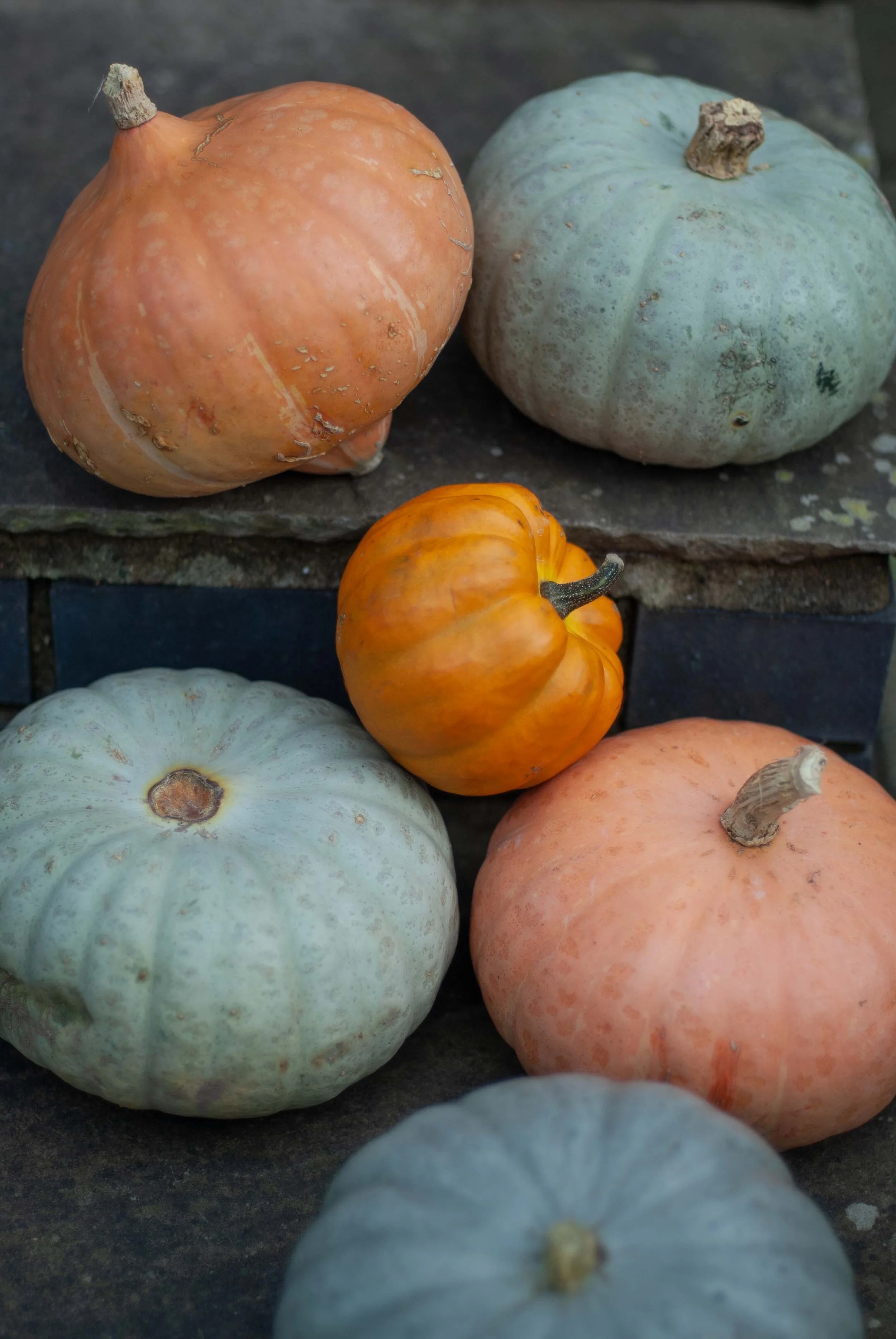
A selection of pumpkins from my Cardiff garden.
Pumpkins have been grown in Europe, the Middle East and the Americas since antiquity. They come in all shapes, sizes and colours, and are often ribbed. They can be an elegant blue or rich orange, white, greenish white, yellow, sometimes spotted or streaked. They are a fine sight stacked up all together in the local market. The English name ‘pumpkin’ goes back to the seventeenth century, almost certainly derived from the old French word, pompom from the Classical Greek pepon. The Narragansett Native American word askutasquash was anglicised to ‘squash’ by early seventeenth-century European colonists in New England.
Pumpkins are known to have been grown in the kitchen garden on Paris’s Île de la Cité in the fourteenth century: they are described in a fascinating manuscript entitled Le Ménagier de Paris.
In Charles Perrault’s 1697 fairy tale Cinderella, the fairy godmother transforms a humble pumpkin into a glorious golden carriage:
Then she took her into her chamber, and said to her: ‘Run into the garden and bring me a pumpkin’. Cinderella went immediately to gather the finest she could get, and brought it to her godmother, not being able to imagine how this pumpkin could help her go to the ball. Her godmother scooped out all the inside of it, leaving nothing but the rind. Having done this, she struck the pumpkin with her wand, and it was instantly turned into a fine coach, gilded all over with gold.
In 1867, Welsh heiress Lady Llanover writes about the British relationship with pumpkins:
Few vegetables are so little understood and consequently so much undervalued in Great Britain as pumpkins. Perhaps Gower in South Wales is the only part of the United Kingdom where pumpkins are grown as an article of diet by the rural population; and they are to be seen, as on the Continent, hanging from ceilings for winter store, and any little spare corner in the field or garden is made use of to place the small mound on which to sow a few pumpkin seeds. The varieties of this plant are so numerous that it would be beyond the limit of any cookery book to attempt an enumeration of comparative merits, from the vegetable marrow to the Turk’s turban and the yellow pumpkin, which grows to such a size as to fill a wheelbarrow.
Once the frost bites, pumpkins should be stored indoors at a low temperature, but not below 6°C. My personal favourite is the rich-fleshed Crown Prince, happily now in season as the autumn days draw in. By hoarding a clutch of in the spare bedroom, I find I can extend their time until March, if I’ve amassed enough. If I’m unable to find Crown Princes, I look for another orange-fleshed type with a low water content, such as butternut squash. If you are a forager – or what my son Alex calls ‘minted’ – you can lift Crown Prince to another level by roasting it alongside some wild mushrooms (see page 180 in my book), which are also now available imported from Eastern Europe at an affordable price.
Pumpkins make an excellent warming soup. Soupe au potiron is a firm favourite in France. Paulette, who was our local farmer’s wife in Marnaves, always ate a substantial meal at lunch and had soup for supper; in the autumn pumpkin soup was often on the menu. The wonderfully nutritious Italian minestrone is delicious with hunks of pumpkin in it – I like to make mine using a base of leeks and celery, and always throw in some parmesan rinds for added depth.
Pumpkin seeds are one of the best natural sources of magnesium (their white skin needs to be removed to reveal the pretty green edible kernels). They are also rich in zinc, fibre and unsaturated fats. Spaniards and Mexicans delight in eating them raw or roasted as snacks – as do I!