
jane grigson
The food writer Jane Grigson has a special place in my culinary heart. I fell in love with her back in 1968, when she began writing a weekly column in the Observer. That was the year I went up to York University to read Music, and after spending a miserable day trying to find digs, my wonderful Aunt Judith, who lived there, asked me whether I’d consider staying with her. My response was an immediate and resounding ‘yes’! The week I moved in, the first of Jane Grigson’s Observer articles appeared. Judith was a passionate and very talented cook and she and I would wait with bated breath for the next instalment. Those recipes were later re-published in 1971, in her second book Good Things, which she aptly describes as ‘a book about enjoying food’. In it she writes:
Kitchens should be thought of as the centre of the house. They need above all a space for talking, playing, bringing up children, sewing, having a meal, reading, sitting and thinking. One may have to walk about a bit, but where’s the harm in that. Everything will not be shipshape-galley fashion, but it’s in this kind of place that good food has flourished. It’s from this secret retreat that the exploration of man’s curious and close relationship with food, beyond the point of nourishment can start.
I couldn’t agree more – in every house I’ve lived in, the kitchen has always been the hub, to which everyone gravitates. When my three sons were teenagers I spent many happy hours in the kitchen cooking supper, whilst discussing perhaps the Poor Law of 1601 for someone’s history homework. Now the discussions are with my four-year-old grandson, Finley, who has a great relationship with our young Burmese cat. Having a chef for a father, it is not surprising that Finley is deeply interested in food: recently after eating a beautiful peach he said ‘now I’d like something savoury’.
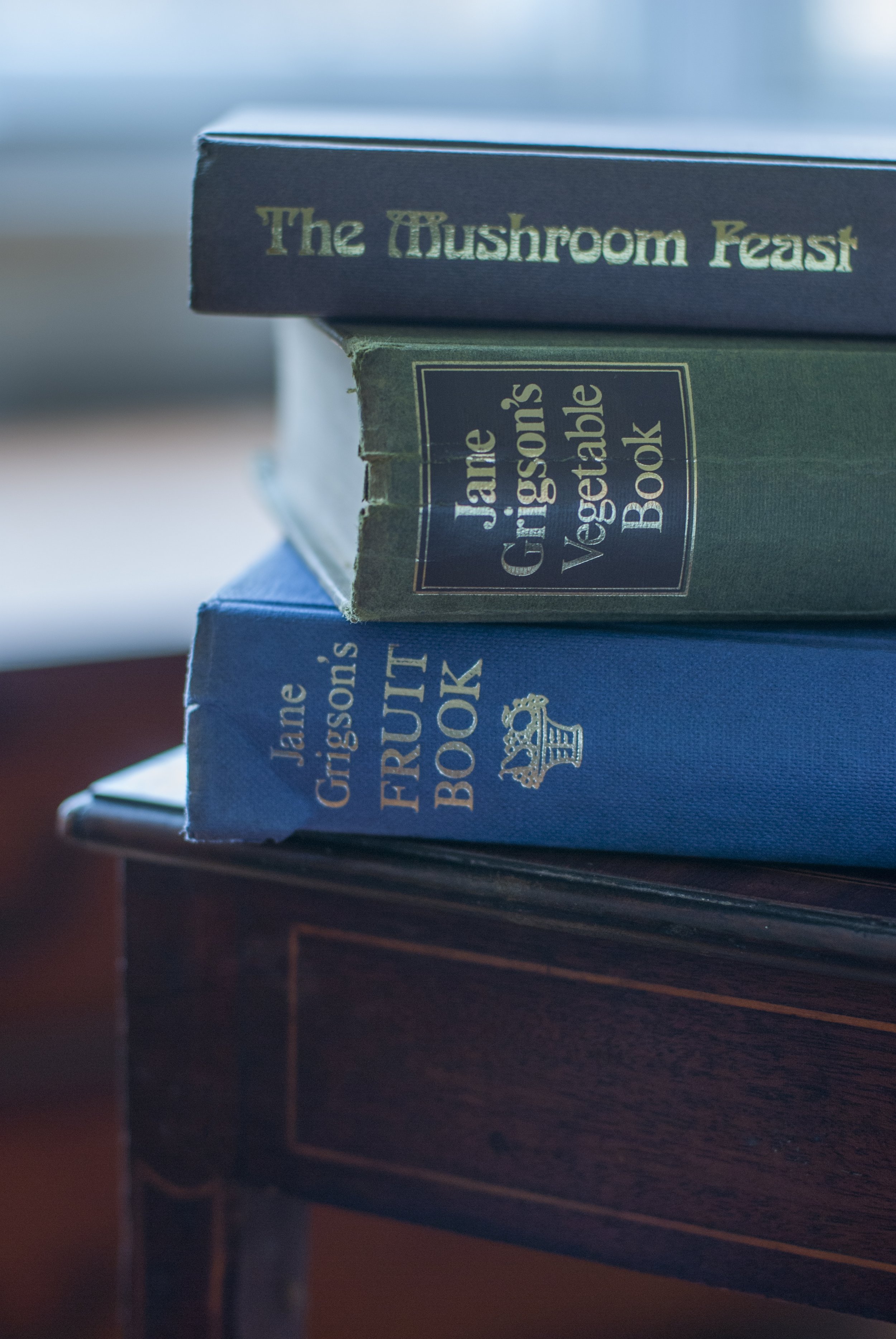
Three favourite titles in my well-thumbed Jane Grigson collection.
Like I do, Jane Grigson had a second home in France. Hers was in the Bas-Vendômois, in the Loir-et-Cher, and ours is the Tarn. It was during her time in France that she turned to writing about food. One subject close to the heart of both our fellow villagers is mushroom hunting, the theme of her subsequent book The Mushroom Feast. When we first arrived in Marnaves, only the oldest Marnavois families were permitted to buy a licence to forage for mushrooms. Now we can all buy one, for €10 a year. Once, whilst I was walking back from the boulangerie, I bumped into a woman descending from the causse (a rocky, limestone plateau above our village) who was carrying at least two kilos of perfect cèpes – they smelt fantastic! We were in the midst of running a Baroque music summer school at that moment, and she gave me all she had gathered to share with the students – I was stunned! Later, we all joyously tucked into cèpes for supper, cooked with some garlic and a very small amount of olive oil. Tragically, due to global warming and the complete absence of late summer rain over the last 10 years, the annual late summer mushrooms have all but disappeared. The villagers are deeply bereaved and angered by the lack of consideration for the balance of nature by the big multinationals.
For me, Jane Grigson’s Vegetable Book and Fruit Book are her greatest achievements – I just love them. I’ve read and re-read them, fascinated not only by her excellent recipes but also her wonderfully informative introductions to each vegetable and fruit. Her prose is a joy to read: straightforward, friendly and beautifully lucid. The books are very much of their time, but no less useful or edifying because of it. On a recent re-reading, it was interesting to rediscover her notes about seventeenth-century horticulturalist John Evelyn growing rocket alongside corn salad, clary and purslane. When Jane Grigson was writing in 1978 they had ‘disappeared from our salad bowls’, but are now, happily, enjoying a revival.
It was from Jane Grigson that I learned about the aubergine. Though strongly associated with Mediterranean food, it actually hails from tropical Asia. And, as she explains, ‘it carries its history in its name aubergine, the French name we have adopted goes back through Catalan alberginera, Arabic al-badinjan, Persian badin-gan to Sanskrit vatin-ganah’. It was in this section of her book that I discovered Parmigiana di melanzane – an Italian recipe using the aubergine’s Italian name melanzane. (Later this month I will share my own recipe for this favourite dish.)
At the beginning of her Fruit Book, Jane Grigson quotes John Evelyn’s exquisite prose on the subject of fruit gardens:
A handsomely contrived, and well furnished Fruit garden is an Epitomy of Paradise, which was a most glorious place without a palace.
Moving to the subject of peaches, she begins with the French theatre and food journalist James de Coquet’s recollection:
Renoir used to say to young artists longing to paint – like him – the pinkish-brown tones of an opulent breast: “First paint apples and peaches in a fruit bowl”.
These were, surely, the very sweet pêches blanches. At our house in France, two of my sons lovingly built a handmade four à bois (see my journal post ‘chickpea flour’). The most divine way to finish off a summer meal is to bake halved pêches blanches, filling their centres with a little unsalted butter and some dark miel de châtaigner (chestnut honey), in the wood-fired oven. They don’t take very long to cook when the oven is fired up to 450°C!
The celebratory feel of beautiful, seasonal fruit is summed up so perfectly by Jane G:
This special feeling towards fruit, its glory and abundance, is I would say universal. We respond to strawberry fields or cherry orchards with a delight that a cabbage patch or even an elegant vegetable garden cannot provoke. Such feelings towards fruits have made this book more fun to write than any of the others. As with vegetables, what moved me about fruit was the centuries of patient work that have built up the repertoire of apple, pear and strawberry varieties, that have developed cherries, peaches, plums and citrus fruits for different tastes and places.
If you don’t already know her wonderful food writing, I urge you to seek it out!