
three italian cheeses
I have a problem with cheese: I can only eat certain artisan varieties, and even then can only consume a small amount before the symptoms of my allergies kick in (my thinking becomes blurred, my nose gets blocked and I need to continuously clear my throat). As a rule, I only eat artisan-made sheep and goat’s cheeses (which I greatly enjoy) in moderation – so artisan ewe’s milk ricotta and buffalo milk mozzarella are both good choices for me. I can also tolerate top-quality cow’s milk cheeses made from unpasteurised milk to a certain extent too. Happily there are some very fine cheeses made with unpasteurised cow’s milk – and Parmigiano Reggiano is one of my absolute favourites.
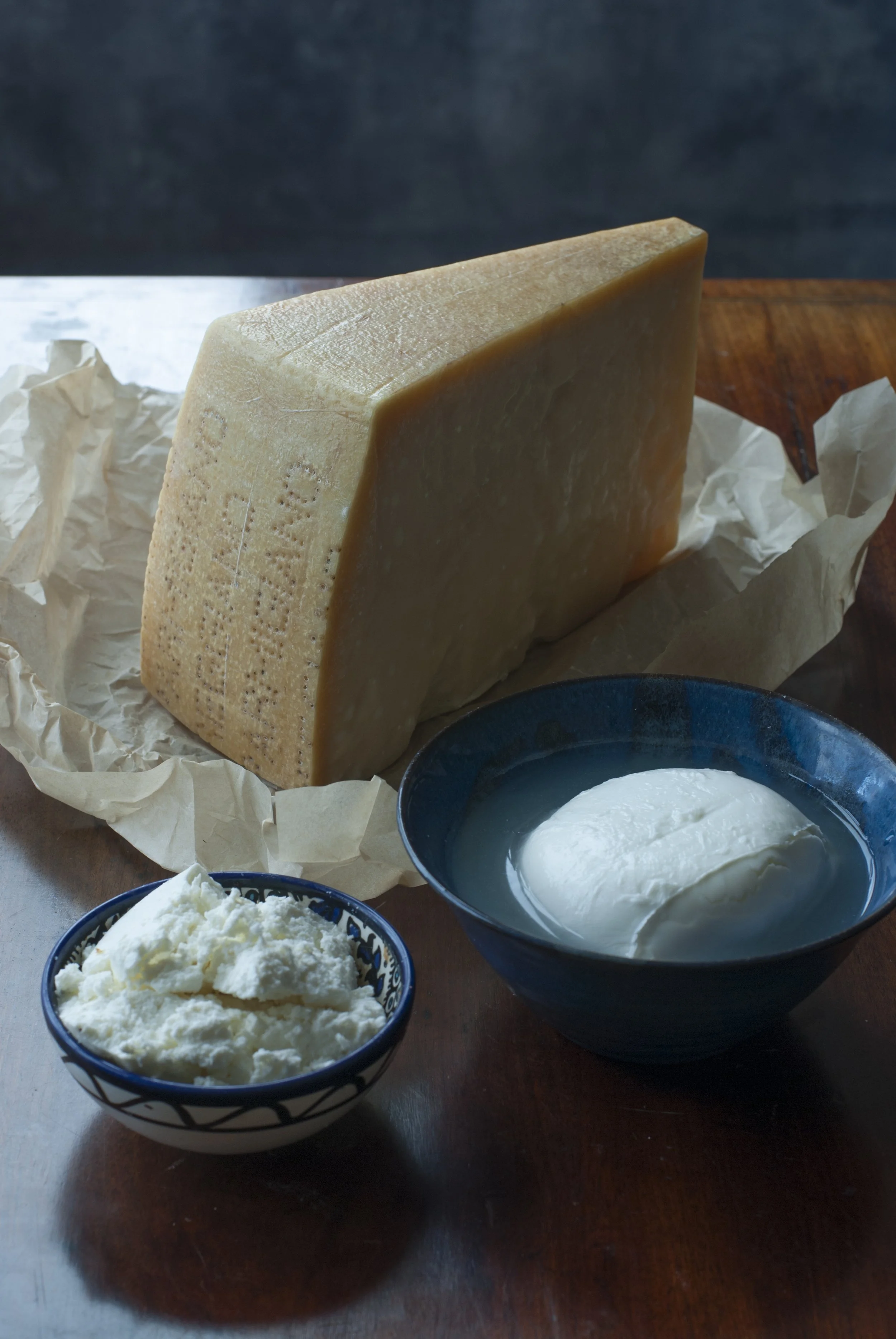
Clockwise from top: a magnificent hunk of Parmiggiano-Reggiano, a ball of milky-white mozzarella di bufala sitting in its brine, and some mild, creamy ewe’s milk ricotta.
One of my most cherished foodie memories was one spring in Tuscany, when the cherries were just ripe. We were staying at the country house of our dear friend Giovanna’s parents. Our first morning, Giovanna introduced us to a special local treat: freshly made ewes’ milk ricotta that had been prepared so recently that it was still warm! It was breathtakingly delicious and creamy and we ate it with a little local honey drizzled over it. Perhaps the most perfect breakfast I have eaten. Our holiday had started on a high note!
We went on to sample Giovanna’s parents’ memorable bottled tomatoes, olive oil, red and white wine, vin santo and fantastic limoncello. Each bottle was opened with anticipation and everyone tasted a bit to assess its salient merits – it made the uniformity of commercial wine suddenly seem rather boring. The Carabinieri (regional police) apparently keep a friendly eye on the locals’ ventures in distilling, but as long as they are given some to sample, no one bothers further. What a wonderful window into the ways of rural Tuscans!
Ricotta is made from whey, often the whey left over from the production of cheese such as provolone. Ricotta means ‘recooked’, referring to the fact that the original milk is heated to separate the curds from the whey, before a second ‘cooking’, where the whey is raised to a high temperature to make the ricotta. A little sour whey or some other coagulant is added once the whey has been heated, to encourage the formation of the second quota of curd.
When in France, we can buy beautiful sheep’s ricotta in Cordes Market. My neighbour Hélène has created a popular picnic finale, serving said ricotta with a drizzle of local honey and a sprinkling of freshly picked thyme. I also like to stuff baked courgettes with ricotta mixed with fried onions and herbs, returning them to the oven until they are sizzling. Soft, light ricotta lends itself to desserts. A favourite of mine is Sicilian Ricotta Cake (see page 242 of my book), which juxtaposes the creamy ricotta with tangy dried cranberries.
Sixteenth-century Italian cookery writer Bartolomeo Scappi’s celebrated L’Arte et Prudenza d’un Maestro Cuoco, published in 1570, gives us the earliest documented reference to mozzarella di bufala (buffalo mozzarella). Scappi was chef to Pope Pius IV and his publication was the first printed cookbook to have illustrations. There’s a charming woodcut depicting the main kitchen with a kitchen boy keeping the stove going and a dish of pasta sitting ready on a table with a pasta cutter beside it.
Interestingly, Italian water buffalo are genetically linked to Indian water buffalo, which date back to at least 2000 years BCE. They travelled via Mesopotamia to North Africa and from thence, around the ninth century, with the Saracens to Sicily.
Mozzarella is made using the pasta filata (stretched curd) technique and, like ricotta, is a southern Italian cheese. It melts spectacularly well and is used in cooking, notably for pizza and melanzane di parmagiana, as well as appearing on the cheese board, and in a classic Caprese salad with basil and tomatoes.
I try always to have some Parmigiano Reggiano at the ready in my fridge. It keeps extremely well and is incredibly useful: a little piece grated in an omelette or over a seasonal beany minestrone, or a hunk of its rind to flavour a soup, or, along with mozzarella in the classic melanzane di parmagiana.
Parmigiano Reggiano is a hard, unpasteurised cows’ milk from the northern Italian provinces of Parma and Reggio Emilia. It is carefully aged for as much as 36 months, which includes being submerged for 20 days in tanks of brine made with sea salt from the Mediterranean. Around 4 million wheels of authentic Parmigiano Reggiano are produced in a year, with each wheel weighing around 40kg.
Parmesan has a long history. As far back as 1348, Italian writer and poet Giovanni Boccaccio tells a story in his Decameron of ‘a mountain, all of grated Parmesan cheese’ with people living on it devoted to making macaroni and ravioli. Parmesan cheese became so highly valued that in 1511 Pope Julius II rewarded Henry VIII with 100 wheels of Parmesan for assisting him in fighting the French! In the midst of the Great Fire of London (on Tuesday 4 September 1666, to be precise), diarist Samuel Pepys writes: ‘Up by break of day to get away the remainder of my things … And in the evening Sir W. Pen and I did dig another [pit in the garden], and put our wine in it; and I my Parmazan cheese … ’
Both mozzarella di bufala and Parmigiano Reggiano have PDO (protected designations of origin) status; as do two specific varieties of ricotta: ricotta di bufala Campana and ricotta Romana.
In short, these three cheeses of extraordinary and subtle character play an invaluable role in my kitchen.